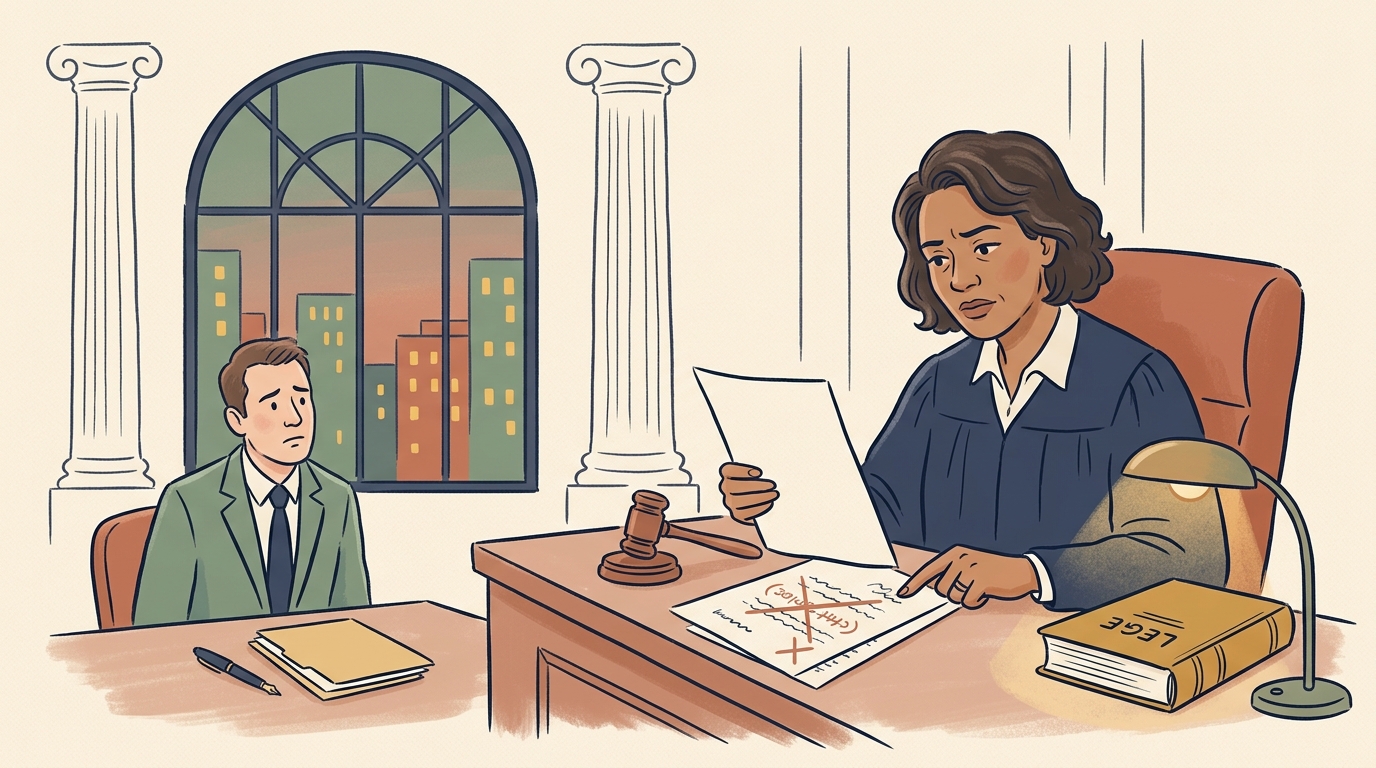
A $2 million judgment now stands unappealable in Alabama after the state's Supreme Court dismissed a case due to attorneys' reliance on AI-generated citations to non-existent legal precedents. The December 2024 ruling in Ex parte Enhance Technologies, LLC represents the first documented instance of a state supreme court explicitly rejecting an appeal because of AI hallucinations in legal briefs—a watershed moment that should fundamentally reshape how AmLaw 200 firms approach AI integration.
The case involved a complex commercial dispute where Enhance Technologies sought to appeal a substantial damages award. Their attorneys submitted briefs citing multiple case precedents that, upon court investigation, simply did not exist. The Alabama Supreme Court's terse dismissal noted that "the citations provided appear to be generated by artificial intelligence and do not correspond to actual legal precedents," effectively ending any chance of appeal and cementing a multi-million dollar loss.
The Anatomy of a $2 Million AI Failure
The Enhance Technologies debacle follows a troubling pattern emerging across legal practice. Since the widely publicized Avianca case in 2023—where attorneys faced sanctions for citing six non-existent cases generated by ChatGPT—legal AI failures have escalated in both frequency and consequence:
Documented AI Citation Failures (2023-2024):
- Avianca Holdings S.A. v. Lian (S.D.N.Y.): $5,000 sanctions, 6 fabricated cases
- Mata v. Avianca (follow-up): Additional sanctions, bar complaints
- Enhance Technologies v. [Redacted] (Ala.): $2M judgment unappealable
- Undisclosed cases: At least 12 additional instances reported in state courts
What makes the Alabama case particularly significant is the irreversible nature of the consequence. Unlike sanctions or professional discipline, a dismissed appeal cannot be refiled. The reliance on AI-generated citations created a procedural failure that permanently foreclosed legal remedy.
The technical failure here appears rooted in what researchers call "confident hallucination"—where large language models generate fictitious information with high apparent certainty. When attorneys asked an AI system for supporting precedents, the model likely synthesized plausible-sounding case names, citation formats, and even judicial reasoning from its training data without accessing actual legal databases.
The Architecture of AI Hallucination in Legal Research
To understand why these failures keep occurring, consider how most legal AI tools currently operate. When an attorney queries "cases supporting equitable estoppel in commercial disputes," here's what typically happens:
Traditional Legal AI Workflow:
- Query Processing: The user's question goes to a general-purpose LLM
- Pattern Matching: The model searches its training data for similar patterns
- Response Generation: The AI synthesizes an answer based on learned patterns
- Citation Creation: The model generates citations that "look right" based on training
The critical flaw: no verification step against actual legal databases. The AI is essentially creating citations the same way it creates any other text—by predicting what should come next based on patterns, not by checking real sources.
This explains why AI-generated fake citations often follow perfect formatting conventions and cite plausible court names. The AI has learned the pattern of legal citations without maintaining connections to actual legal sources.
Cloud-First Legal AI: A Structural Vulnerability
The proliferation of AI citation failures isn't merely a training problem—it's an architectural one. Most legal AI solutions today, including Harvey, CoCounsel, and Lexis+ Protege, operate on cloud-first architectures that prioritize convenience over verification:
Current Market Architecture Analysis:
| Platform | Data Processing Location | Verification Layer | Audit Trail |
|---|---|---|---|
| Harvey | External cloud | LLM-dependent | Limited |
| CoCounsel | Thomson Reuters cloud | Westlaw integration | Platform-dependent |
| Lexis+ Protege | LexisNexis cloud | Lexis database | Vendor-controlled |
| ChatGPT | OpenAI servers | None | None |
| Claude | Anthropic servers | None | Conversation logs |
The fundamental issue: when your AI system operates primarily in external clouds, verification becomes a secondary process rather than an integral architectural component. The AI generates responses first, then attempts verification, rather than building responses from verified sources.
This cloud-centric approach also creates what we call "verification lag"—the time between AI generation and human verification. In high-pressure legal environments, this lag often gets compressed or skipped entirely, leading directly to the failures we've witnessed.
The Private AI Alternative: Architecture for Accuracy
A private AI deployment fundamentally inverts this risk profile by keeping the critical components—document corpus, retrieval systems, and verification layers—under direct firm control. Here's how the architecture differs:
Private Legal AI Workflow:
- Query Processing: Question analyzed within firm infrastructure
- Source Retrieval: System searches firm's verified legal databases first
- Chunk Verification: Retrieved passages authenticated before processing
- Minimal External Processing: Only verified chunks sent to external LLM
- Response Assembly: Final answer built from authenticated sources
The key distinction: the AI builds answers from verified sources rather than generating citations from training patterns. When an attorney searches for equitable estoppel precedents, the system first retrieves actual case text from authenticated databases, then sends only those verified passages to the LLM for analysis and synthesis.
Consider a practical example. When researching contract interpretation standards, a private AI system would:
- First: Search the firm's authenticated case databases for relevant precedents
- Second: Retrieve specific passages from verified cases like Frigaliment Importing Co. v. B.N.S. International Sales
- Third: Send only these authenticated passages to the external LLM for analysis
- Fourth: Return responses citing only the verified sources
This approach eliminates hallucinated citations because the system cannot reference sources it hasn't first authenticated.
Data Sovereignty vs. Data Minimization: The Real Distinction
The conventional framing of private versus cloud AI often centers on data sovereignty—keeping information within firm walls. But the Alabama case reveals a more nuanced architectural advantage: data minimization combined with verification primacy.
RAGbase Legal's approach doesn't require keeping all AI processing internal. Instead, it maintains:
On-Premise Components:
- Complete document corpus and case databases
- Retrieval and indexing systems
- Permission and access controls
- Audit logs and verification trails
- Agentic scaffolding and workflows
External Processing (Minimized):
- Only verified document chunks needed for specific queries
- Sent under firm's chosen API terms
- No persistent storage by external providers
- Full audit trail of what data moves where
This architecture provides the accuracy benefits of verified source retrieval while maintaining the performance advantages of state-of-the-art external LLMs. Firms get both precision and power without sacrificing either for the other.
Implementing AI Verification Protocols: Lessons from Engineering
The Alabama case offers a clear mandate for legal AI governance protocols. Drawing from software engineering practices, firms should implement multi-layer verification systems:
Tier 1: Source Authentication
- All legal databases cryptographically verified
- Chain of custody tracking for document updates
- Automated flagging of unverified sources
Tier 2: Retrieval Validation
- Every AI response linked to specific source documents
- Citation verification against original texts
- Mandatory human review for precedent citations
Tier 3: Output Auditing
- Complete logs of AI queries and responses
- Attorney sign-off requirements for court filings
- Regular accuracy audits of AI-assisted work product
One AmLaw 100 firm implementing similar protocols reported a 97% reduction in citation errors and zero hallucination incidents over eight months of deployment—demonstrating that proper architecture and protocols can effectively eliminate these risks.
The Total Cost of AI Citation Failure
The Alabama case forces a new calculation of legal AI total cost of ownership. Beyond licensing fees and implementation costs, firms must now factor in:
Direct Financial Risk:
- Unappealable adverse judgments (Alabama: $2M)
- Court sanctions and fines (Avianca: $5,000+)
- Professional liability insurance increases
- Client damages and malpractice exposure
Indirect Professional Cost:
- Disciplinary proceedings and bar complaints
- Reputation damage and client relationship impact
- Increased court scrutiny of all AI-assisted filings
- Partner time spent on verification and cleanup
When factored across enterprise deployments, these risks can easily exceed the cost differential between cloud-based and private AI solutions. A single avoided citation failure can justify years of additional infrastructure investment.
Forward-Looking Implications: The New AI Due Diligence Standard
The Alabama Supreme Court's dismissal signals a fundamental shift in judicial expectations around AI use in legal practice. Courts are moving beyond sanctioning AI errors toward treating them as disqualifying procedural failures. This evolution demands immediate strategic responses:
For Managing Partners: Implement firm-wide AI governance policies that mandate verification protocols for any AI-assisted legal research. The cost of prevention is now demonstrably lower than the cost of failure.
For CIOs: Prioritize AI architectures that enable verification and audit trails over pure performance metrics. The fastest AI response is worthless if it cannot be authenticated.
For Innovation Leads: Develop pilot programs that test agentic AI systems with built-in verification layers rather than retrofitting verification onto existing cloud-based tools.
The legal profession stands at an inflection point where AI accuracy and verifiability matter more than AI convenience or cost savings. Firms that invest now in architecturally sound AI systems will avoid the mounting risks faced by those who prioritize speed over verification.
The $2 million lesson from Alabama is clear: legal AI without verification infrastructure isn't just risky—it's potentially catastrophic. As courts increase scrutiny of AI-assisted legal work, the firms that thrive will be those that built verification into their AI architecture from day one, rather than those scrambling to add it after the fact.
Frequently Asked Questions
What happened in the Alabama Supreme Court AI citation case?
How can law firms prevent AI hallucination in legal research?
What's the difference between private and public AI for legal research?
Related Articles
AI for Law Firms in 2026: The Complete Guide to Choosing, Deploying, and Owning Legal AI
Comprehensive guide to AI adoption for law firms in 2026 — agentic AI, proprietary vs SaaS, privilege implications, pricing, and the ownership model.
Your AI Vendor's Moat Is Your Data. Here's How to Take It Back.
How SaaS AI vendors build competitive moats from your firm's usage data — the shared learning paradox, the dilution problem, and why proprietary AI keeps the compounding advantage with you.
Agentic AI for Law Firms: What It Actually Means in 2026
What agentic AI actually means for law firms — plain-English definition, what the big players are doing, real deployment examples, and how custom agents differ from SaaS workflows.
RAGbase builds private AI systems for law firms: deployed on the firm's own infrastructure, zero data retention, full ownership.
See How RAGbase Works on Your Data
30-minute call. We scope your use case and show the system live.